Polymer Grinding: Challenges and Industrial Solutions
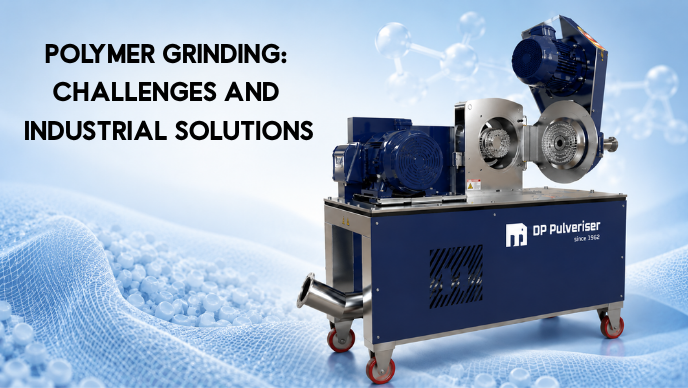
In modern manufacturing, polymers are widely used across industries such as plastics, automotive, packaging, masterbatch, rotomoulding, and recycling. However, achieving the required particle size during polymer grinding is not always easy.
Unlike conventional materials, polymers behave differently during size reduction due to their flexible structure, heat sensitivity, and varying melting points. This makes selecting the right grinding technology extremely important for maintaining product quality and production efficiency.
What is Polymer Grinding?
Polymer grinding is the process of reducing plastic or polymer materials into fine powder for further industrial applications. Depending on the application, polymers may be processed into coarse granules or ultra-fine powder.
Commonly processed polymers include:
- PVC
- PE
- HDPE
- LDPE
- EVA
- PP
- ABS
- Nylon
- Engineering plastics
These powders are used in:
- Rotomoulding
- Plastic compounding
- Masterbatch production
- Recycling processes
- Plastic extrusion applications
Major Challenges in Polymer Grinding
Heat Generation During Grinding
One of the biggest challenges in polymer processing is excessive heat generation. Many polymers soften or melt when exposed to high grinding temperatures.
This can result in:
- Material sticking
- Screen choking
- Reduced production efficiency
- Poor powder quality
- Machine downtime
Maintaining Uniform Particle Size
Industries require consistent particle size for smooth downstream processing. Irregular particle size distribution can affect:
- Product quality
- Mixing performance
- Flow properties
- End-product consistency
Achieving uniform fineness requires proper machine selection and optimized grinding conditions.
Handling Flexible & Elastic Materials
Some polymers are naturally flexible and difficult to grind using conventional milling systems. Instead of breaking properly, the material may deform during grinding.
This creates:
- Low output
- High energy consumption
- Inconsistent grinding results
Dust Control & Material Handling
Fine polymer powders can create dust handling challenges during production. Proper dust collection and airflow management are essential for:
- Workplace safety
- Clean operation
- Efficient material transfer
- Reduced product loss
Industrial Solutions for Efficient Polymer Grinding
Cryogenic Grinding Technology
Cryogenic grinding is one of the most effective solutions for heat-sensitive polymers.
In this process, materials are cooled using liquid nitrogen before grinding. Low temperatures make polymers brittle, allowing efficient size reduction without melting issues.
Benefits include:
- Reduced heat generation
- Better particle size control
- Higher production efficiency
- Improved powder quality
- Lower material degradation
Cryogenic systems are especially useful for:
- Engineering plastics
- Heat-sensitive polymers
- Specialty compounds
Contra Pin Mill for Polymer Grinding
The Contra Pin Mill is widely used in polymer grinding applications due to its high-speed impact grinding mechanism.
It helps achieve:
- Fine powder output
- Better cooling effect
- Uniform particle size
- Efficient grinding performance
This system is particularly suitable for:
- PVC powder production
- Plastic recycling
- Polymer compounds
- Cryogenic grinding setups
Air Classification Systems
Modern polymer grinding plants often include air classification systems for accurate particle size separation.
Advantages include:
- Narrow particle size distribution
- Consistent powder quality
- Better production control
- Reduced oversized particles
Why Choosing the Right Grinding System Matters
An efficient polymer grinding system helps industries:
- Improve production consistency
- Reduce operational downtime
- Minimize heat-related issues
- Achieve better product quality
- Increase overall productivity
Selecting the right technology depends on:
- Polymer type
- Required fineness
- Production capacity
- Heat sensitivity
- End-use application
Final Thoughts
Polymer grinding requires more than just high-speed size reduction. Heat control, particle size consistency, airflow management, and machine selection all play a critical role in achieving efficient production.
With advanced grinding solutions like cryogenic systems and Contra Pin Mills, industries can process polymers more effectively while maintaining high-quality output and operational efficiency.
Industrial grinding technology continues to evolve, helping manufacturers meet growing demands for precision polymer processing.