How Airflow Affects Pulveriser Performance
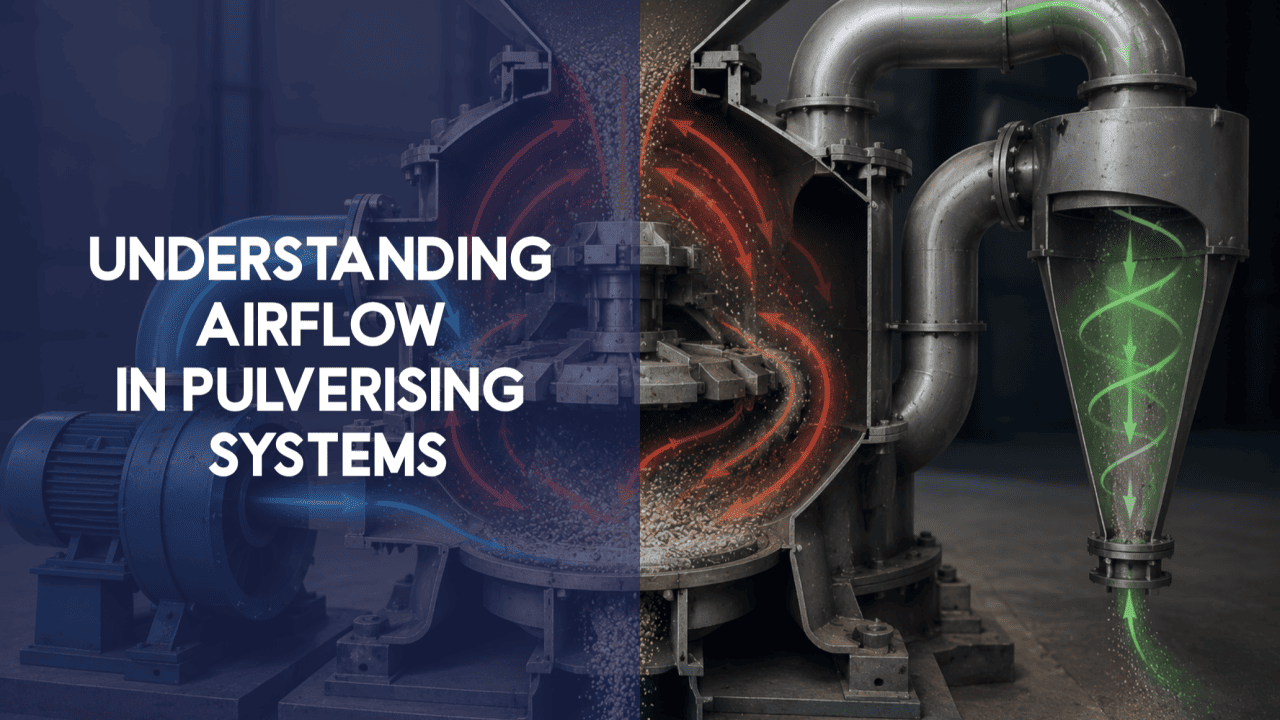
In industrial pulverising systems, airflow is a critical factor that directly impacts grinding efficiency, particle size control, throughput, temperature management, and overall powder quality.
While rotor speed and grinding components often receive the most attention, an optimized airflow system can significantly improve productivity, reduce energy consumption, and deliver more consistent results. Poor airflow, on the other hand, can lead to overheating, material buildup, reduced efficiency, and inconsistent product quality.
Understanding Airflow in Pulverising Systems
Airflow helps transport material through the grinding chamber while controlling particle movement during size reduction. In advanced systems such as Air Classifier Mills, airflow also supports particle classification and separation.
The airflow system typically works in coordination with:
- Grinding Rotor
- Classifier System
- Cyclone Separator
- Dust Collector
- Blower/Fan System
Together, these components create an efficient grinding and powder handling process.
Why Airflow Matters
1. Better Particle Size Control
Airflow determines how long particles remain inside the grinding chamber.
- Higher airflow removes fine particles quickly.
- Lower airflow may cause excessive recirculation and over-grinding.
Balanced airflow helps achieve uniform particle size and consistent product quality.
2. Improved Grinding Efficiency
Proper airflow reduces material congestion and allows smoother movement through the grinding zone.
Benefits include:
- Higher throughput
- Better grinding performance
- Reduced power consumption
Poor airflow can result in choking, lower capacity, and reduced efficiency.
3. Temperature Management
Fine grinding often generates heat, especially when processing spices, herbs, chemicals, pharmaceuticals, and polymers.
Optimized airflow helps remove excess heat, reducing the risk of product degradation, discoloration, melting, or sticking.
4. Enhanced Product Quality
Stable airflow creates consistent grinding conditions that support:
- Uniform fineness
- Better flow properties
- Consistent bulk density
- Reduced contamination
This is particularly important for applications requiring precise particle size control.
5. Effective Dust Collection
Controlled airflow improves cyclone and dust collector performance by efficiently transporting fine particles through the system.
This helps maintain cleaner production environments while supporting workplace safety and equipment reliability.
Common Airflow Issues
Excessive Airflow
- Reduced residence time
- Coarser product output
- Lower grinding efficiency
Insufficient Airflow
- Material buildup
- Overheating
- Reduced throughput
- Inconsistent powder quality
Regular monitoring is essential to maintain the correct airflow balance.
Modern Airflow Optimization
Today's pulverising systems use advanced airflow engineering to improve process performance, including:
- Dynamic air classification
- Adjustable airflow controls
- High-efficiency cyclones
- Pressure monitoring systems
- Optimized duct layouts
- Energy-efficient blowers
These technologies help improve grinding efficiency, product consistency, and overall plant productivity.
Conclusion
Airflow is one of the most important factors influencing pulveriser performance. It affects particle size distribution, grinding efficiency, temperature control, throughput, and product quality.
A well-designed airflow system ensures smoother operation, higher productivity, and more consistent results, making it an essential part of modern powder processing solutions.