Why Trial & Testing Matters before Selecting an Industrial Grinding Solution
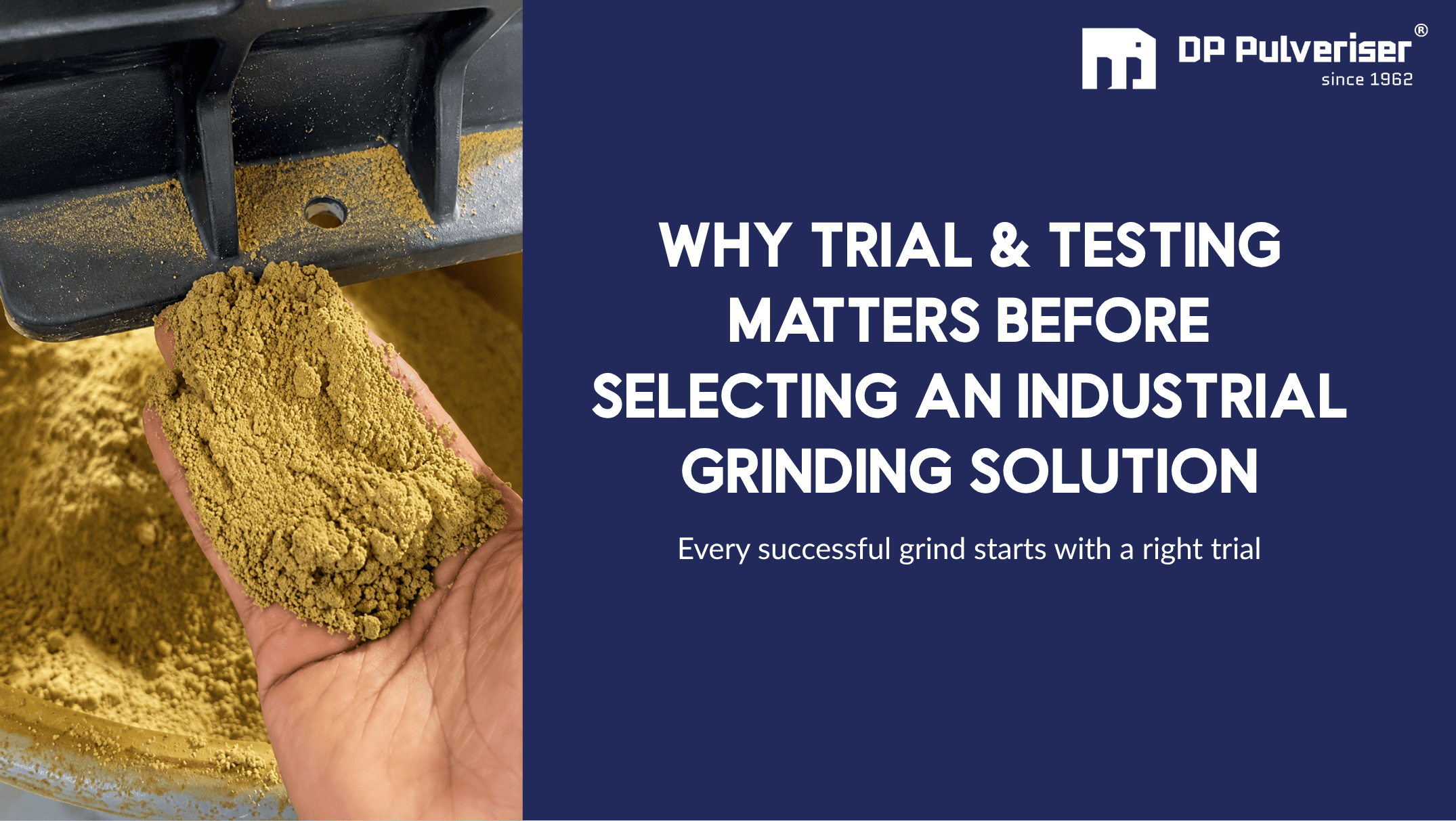
Selecting a grinding system is not only about machine capacity or technical specifications. The actual performance of any powder processing solution depends on how the material behaves under real processing conditions.
Every material responds differently during grinding. Parameters such as hardness, moisture content, heat sensitivity, bulk density, and required particle size can directly impact output quality and process efficiency.
That is why trial and testing play a critical role before finalizing a grinding solution.
Understanding Material Behaviour Before Scale-Up
Laboratory and pilot-scale trials provide valuable insights before moving into commercial production.
Testing helps evaluate:
- Particle size distribution
- Throughput capability
- Product temperature during processing
- Flow characteristics
- Yield and recovery
- Energy consumption
- Product consistency
Rather than relying on assumptions, testing delivers measurable process data that supports informed decision-making.
Why Industrial Trials Reduce Operational Risk
Implementing a grinding system without validation can lead to multiple production challenges, including:
- Inconsistent powder quality
- Higher rejection rates
- Excessive energy consumption
- Reduced production efficiency
- Difficulty achieving target fineness
- Unexpected process limitations
Running structured trials helps identify these factors early and allows process optimization before installation and full-scale production.
Key Parameters Evaluated During Grinding Trials
1. Feed Material Characteristics
Raw material properties strongly influence grinding performance and final output quality.
Typical parameters evaluated include:
- Hardness
- Moisture content
- Bulk density
- Heat or temperature sensitivity
Understanding these characteristics helps determine the most suitable grinding approach.
2. Required Final Output
Trials help validate whether the desired output can be achieved consistently.
Evaluation includes:
- Target micron range
- Particle shape
- Uniformity
- Product flowability
Testing ensures process feasibility before commercial implementation.
3. Process Performance
In addition to output quality, trials evaluate operational performance such as:
- Machine loading
- Production capacity
- Classification efficiency
- Process repeatability
These observations support reliable scale-up and production planning.
From Testing to Process Confidence
Trial reports provide actionable insights for selecting the right grinding solution for specific applications.
The objective is not simply to produce finer powder.
The real goal is to achieve:
- Consistent product quality
- Controlled processing conditions
- Predictable production performance
- Long-term operational efficiency
Why Trial & Testing with DP Makes the Difference
At DP, trial and testing are designed not only to verify particle size but to evaluate the complete grinding approach before project execution.
Application-Based Testing
Trials are conducted based on actual material characteristics and target output requirements instead of using a standard approach for every application.
Process Validation Before Scale-Up
Testing supports evaluation of whether required fineness, throughput, and product consistency can be achieved under expected production conditions.
Material-Specific Grinding Evaluation
Every material behaves differently during grinding. Trial observations help optimize processing parameters according to application requirements.
Focus on Product Quality Retention
Testing can help assess:
- Temperature impact
- Flow behavior
- Output consistency
- Processing stability
depending on the product and process requirements.
Engineering Support Beyond Machine Selection
The objective is to support customers through process understanding and solution alignment — not simply equipment selection.
Experience Across Multiple Powder Applications
Testing experience across different industries helps support more informed process decisions and evolving production requirements.
Final Thoughts
Industrial grinding performance should be validated through practical testing rather than assumptions.
A structured trial process helps manufacturers improve decision-making, reduce project risk, and support long-term production efficiency.
Better processing decisions begin with tested results — not estimated outcomes.
Ready to Evaluate Your Material?
Before scaling production, validate your process performance through trial and testing.
Connect with DP Pulveriser Industries to understand how your material behaves under actual grinding conditions and make more confident production decisions.