Why Turmeric Loses Color During Grinding: Process Challenges and Solutions for Premium Turmeric Powder Production
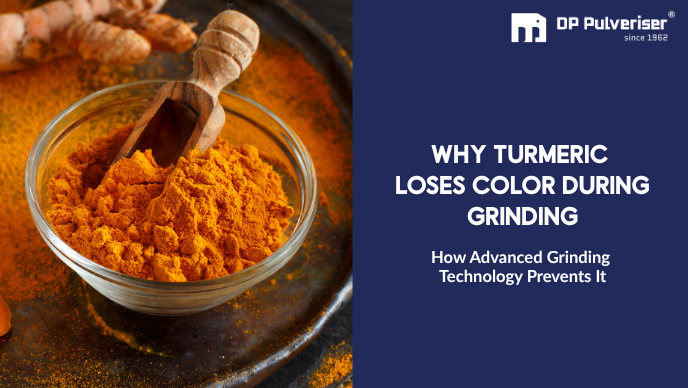
Turmeric is one of the most valuable spices in the global food and nutraceutical industry, prized for its vibrant yellow-orange color and curcumin content. However, many processors face a common challenge during size reduction: loss of color intensity after grinding.
While the raw turmeric may have excellent color value, improper grinding conditions can significantly reduce the appearance, quality, and market value of the final powder.
Understanding why turmeric loses color during grinding is the first step toward producing premium-quality turmeric powder consistently.
The Science Behind Turmeric Color
Turmeric derives its characteristic color from natural pigments known as curcuminoids, primarily curcumin.
These compounds are sensitive to:
- Excessive heat
- Oxidation
- Prolonged residence time
- High mechanical stress
When exposed to unfavourable grinding conditions, curcumin degradation can occur, resulting in:
- Duller powder appearance
- Reduced brightness
- Lower export quality
- Potential reduction in active compound retention
Major Causes of Color Loss During Grinding
1. Excessive Heat Generation
Heat is the most common reason for turmeric color degradation.
During grinding, friction between:
- Rotor and stator
- Grinding elements
- Product particles
creates heat inside the mill chamber.
If temperatures rise excessively:
- Curcumin pigments begin to degrade
- Essential oils evaporate
- Powder color becomes darker and less vibrant
2. Inadequate Airflow Management
Poor airflow inside the grinding system allows heat to accumulate.
Without efficient air movement:
- Product remains longer inside the grinding chamber
- Temperature increases rapidly
- Color quality deteriorates
An optimized airflow system helps remove heat and maintain product quality.
3. Over-Grinding
Many processors attempt to achieve extremely fine particle sizes through repeated grinding.
Over-grinding can lead to:
- Increased friction
- Higher product temperature
- Pigment degradation
- Reduced powder brightness
Finding the correct balance between fineness and product quality is essential.
4. Improper Feeding Rate
Uneven or excessive feeding creates unstable grinding conditions.
This can cause:
- Mill overloading
- Higher energy consumption
- Increased heat generation
- Inconsistent particle size
Controlled feeding helps maintain stable process temperatures.
5. Poor Raw Material Preparation
Turmeric with high moisture content can create additional challenges during grinding.
Excess moisture may cause:
- Material build-up
- Increased friction
- Reduced grinding efficiency
- Higher operating temperatures
Proper drying before grinding significantly improves final powder quality.
How Advanced Grinding Systems Help Preserve Turmeric Color
Modern spice grinding plants are specifically designed to minimize thermal degradation and protect product quality.
Temperature-Controlled Grinding
Advanced pulverising systems reduce heat generation through:
- Optimized rotor design
- Efficient grinding geometry
- Controlled peripheral speeds
- Continuous cooling airflow
This helps preserve both color and aroma.
High-Efficiency Air Handling Systems
Integrated air handling systems:
- Rapidly remove heat from the grinding zone
- Improve product transport
- Reduce residence time
- Maintain consistent powder quality
Accurate Particle Size Control
Proper classification systems prevent unnecessary over-grinding.
Benefits include:
- Better color retention
- Higher productivity
- Lower energy consumption
- Consistent powder fineness
Complete Spice Processing Solutions
A well-engineered turmeric grinding plant combines:
- Feeding systems
- Pulverisers
- Air classifiers
- Cyclones
- Dust collection systems
to maintain optimum operating conditions throughout the process.
The DP® Pulveriser Advantage
At DP® Pulveriser Industries, turmeric grinding solutions are designed to address the critical factors that affect color retention and powder quality.
- Our integrated spice processing systems focus on:
- Controlled grinding temperatures
- Optimized airflow management
- Efficient product classification
- Consistent particle size distribution
- Reduced thermal degradation
- High-quality export-grade turmeric powder production
By combining advanced grinding technology with process engineering expertise, DP® helps manufacturers achieve superior color retention, improved product quality, and higher processing efficiency.